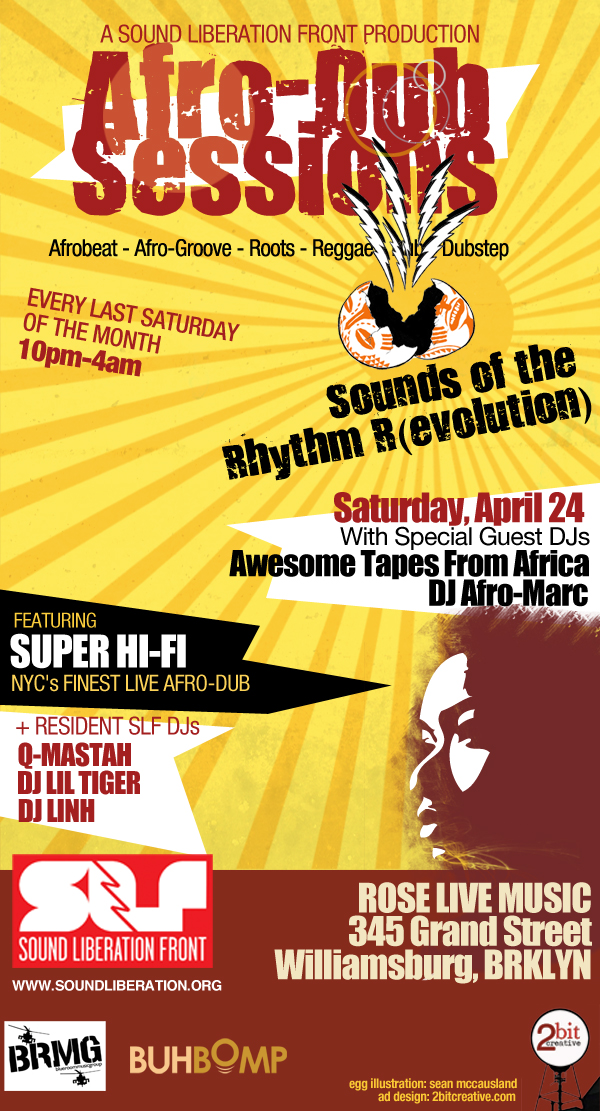
 If you can find your way to Brooklyn this Saturday night, you will forever regret not coming to this party. I'll be on the decks at Rose Live Music along with Brian Shimkovitz from Awesome Tapes From Africa, and resident SLF selectors DJ Linh, DJ Q Mastah, and DJ Lil' Tiger. NY's finest live Afro-Dub collective, Super Hi-Fi, will be hitting the stage. For lovers of African music, this is a night not to be missed.
Wednesday, April 21, 2010
The Afro-Dub Sessions @ Rose Live Music-This Saturday Night
If you can find your way to Brooklyn this Saturday night, you will forever regret not coming to this party. I'll be on the decks at Rose Live Music along with Brian Shimkovitz from Awesome Tapes From Africa, and resident SLF selectors DJ Linh, DJ Q Mastah, and DJ Lil' Tiger. NY's finest live Afro-Dub collective, Super Hi-Fi, will be hitting the stage. For lovers of African music, this is a night not to be missed.

Zozo Afrobeat Speaks out Against Mugabe
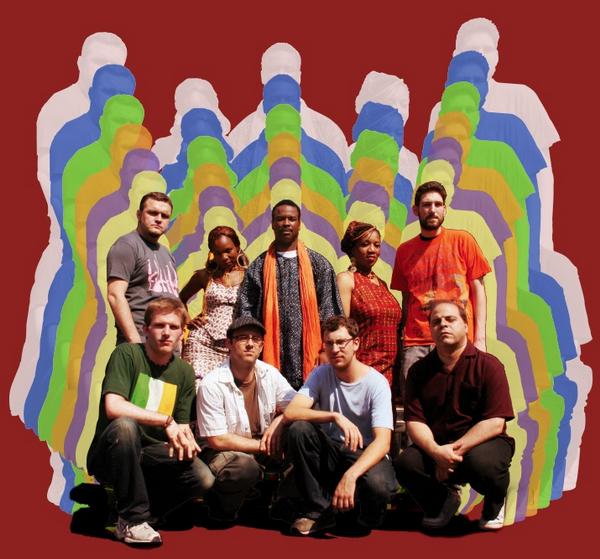 Zozo Afrobeat, a NY afrobeat ensemble led by Egypt 80 vet and Akoya frontman Kaleta, have released a new video calling out Robert Mugabe for his crimes against humanity in Zimbabwe. Zozo will be throwin down this Friday night at Zebulon in Williamsburg. Having seen Zozo several times, I can vouch for their ability to make people dance. Check the video:
Sunday, April 18, 2010
Album Review: Madlib Medicine Show No. 3: Beat Konducta in Africa-Madlib
 Madlib, one of the most distinctively inventive DJ-producers on the planet, has given African music fans a gift. Madlib Medicine Show No. 3: Beat Konducta in Africa, out March 23, 2010 on Stonesthrow Records, is a 44-track masterpiece that draws on a variety of African musical styles from different corners of the continent. Listening to this album is like watching a documentary about Africa in an acid dream.
Madlib uses his characteristically smooth production style to create a transformational soundscape. Almost every track on the album is under two minutes. The grooves are tight and catchy, but they change frequently and don’t always segue easily. Madlib uses the regular changes of pace to his advantage, however, incorporating a wide variety of samples and cuts. It’s almost as if he has musical ADD, changing styles and rhythms every two minutes and cramming as much into every track as possible.
The running commentary from a 1950’s documentary sounding voice sets the mood throughout the album. Madlib seeks to introduce people to the African continent and the diversity of sounds therein. He functions as a musical tour guide, exposing listeners to sounds and influences even avid African music fans will find enlightening.
Madlib has created something that is entirely new and original, yet pays homage to a plethora of established African musical styles. Some tracks are smooth and refined almost like mainstream hip-hop beats, while others are rough and ragged like putting on an old record you found in your uncle’s basement.
Whether you love African music, or simply respect the wizardry of Madlib, this album is totally worth exploring. It will broaden your horizons and make you re-examine conventional hip-hop beats at the same time. Hip-hop wouldn’t be possible without Africa, and Madlib exemplifies exactly how and why.
Tuesday, April 13, 2010
Kora Afrobeat Remix Contest
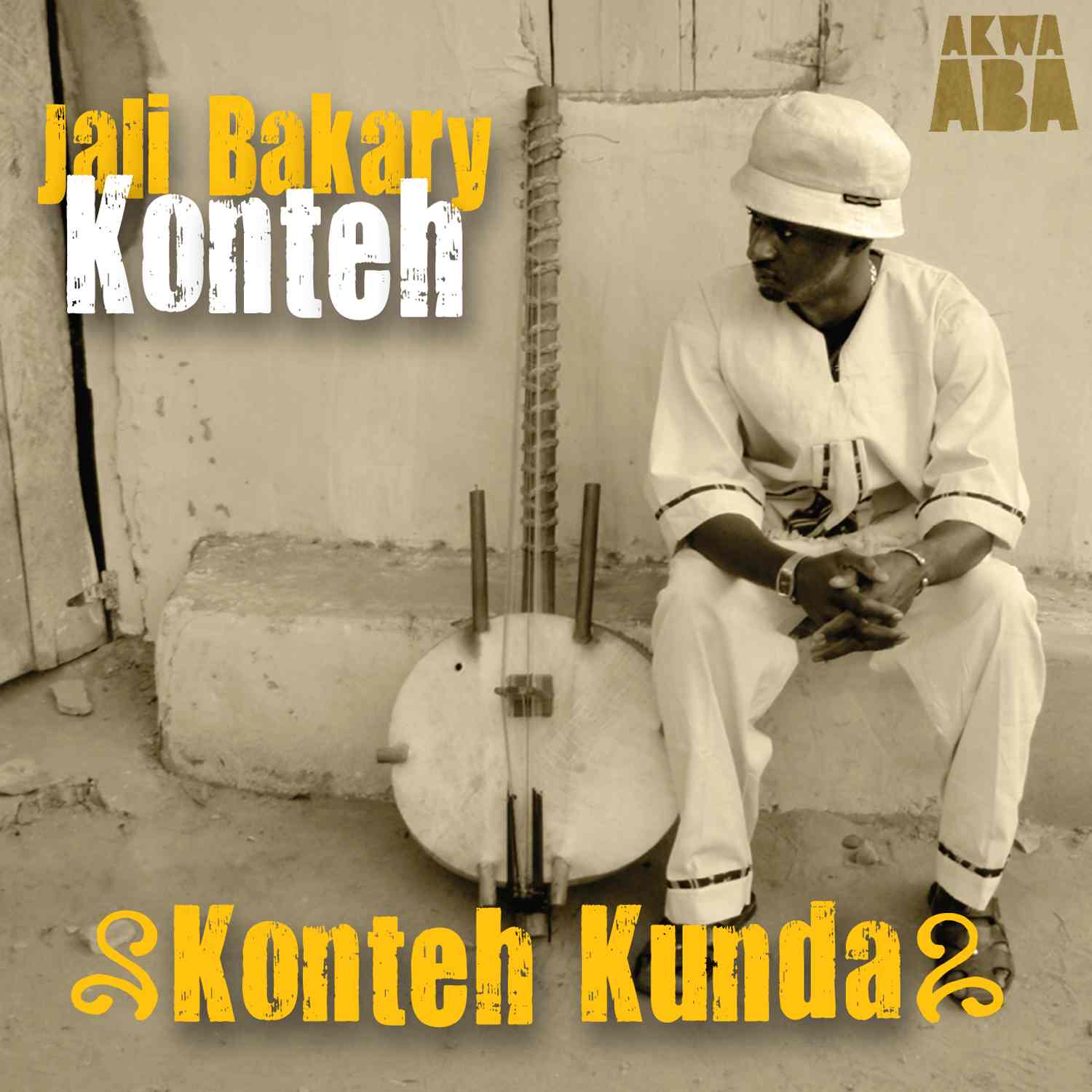 Akwaaba, the fair trade record label doing the most to expose popular African musical styles from every corner of the continent, is throwing a remix contest. Jali Bakary Konteh, a Gambian Kora player, is releasing one of his tracks here. The best remix will be selected and released by Akwaaba. Try your hand at using the album as inspiration for your own creation.
Thursday, April 8, 2010
Vieux Farka Touré April US Tour
 Vieux Farka Touré has evolved from a young talented African musician into an established star in the international music community. He's on the bill for the July World Cup Celebration Concert along with BLK JKS, Angelique Kidjo, Amadou and Mariam, Parlotones, South African legend Vusi Mahlasela, Tinariwen, The Black Eyed Peas, Carlos Santana, Alicia Keys, and Shakira. He's touring the US this April playing fourteen dates in sixteen days. If you've never seen Vieux in concert before, definitely take advantage of the opportunity:
Check out the interview I did with Vieux in July of 2008
4/11/10 – Ithaca, NY – The Haunt
4/12/10 – Pittsburgh, PA – Rex Theater
4/13/10 – Cleveland, OH - The Grog Shop
4/14/10 – Cleveland, OH – Case Western
4/15/10 – Chicago, IL – Martyrs
4/15/10 – Chicago, IL – Center For Inner City Studies
4/17/10 – St. Louis, MO - Billiken @ St Louis University
4/20/10 – Hattiesburg, MS – Thirsty Hippo
4/21/10 – Tallahassee, FL – Engine Room
4/22/10 – Athens, GA - New Earth Music Festival
4/23/10 – St. Petersburg (Tampa), FL – State Theater
4/24/10 – Miami, FL - Transatlantic Festival @ North Beach Bandshell
4/26/10 – Washington, DC – DC9
4/27/10 – New York, NY – Le Poisson Rouge
Wednesday, April 7, 2010
Afrofunky Tomorrow Night
 Brooklyn's Afrofunkiest Dance Party is going down tomorrow night at Cameo in Williamsburg. Hosts Zongo Junction are joined by The People's Champions, The Drumadics, and DJ Offbeat this month. $5 before 10pm, $7 after. If you're in BK and looking for some Afrofunky flavor, you'll be sure to find it here.
Tuesday, April 6, 2010
Album Review: Seahorse and The Storyteller-Michael Leonhart and the Avramina 7
 Seahorse and The Storyteller, the new album from Micheal Leonhart and Avramina 7 out April 20, 2010 on Truth and Soul Records, is far and away one of the most interesting albums I’ve heard in a long time. The impressive musicianship, the tight rhythms, and the diverse instrumentation all make this album extremely unique.
Michael Leonhart is a veteran musician who has performed with an impressive roster of musicians from A Tribe Called Quest to Yoko Ono. At age 17, he became the youngest person to win a Grammy in the award’s history. His work as a multi-instrumentalist, composer, and arranger has gained him various accolades and awards since.
On Seahorse and The Storyteller, Michael Leonhart has recruited an all-star roster of musicians, mostly veterans of the Brooklyn-Daptone scene including Luke O’Malley, Binky Griptite, Tommy Brenneck, Homer Steinweiss, Nick Movshon, Stuart Bogie, Dave Guy, and Mike Williams. If you’re a fan of bands like Budos Band, Antibalas, The Dap-Kings, Superhuman Happiness, or any of the other musicians responsible for the tight funky sound emanating out of Brooklyn these days, I guarantee you will dig this album.
From start to finish, this is a concept album. The lyrics are abstract, and the mood is other-worldly. A wide array of influences and sounds are combined to foster a trademark energy and vibe. While on the road with Steely Dan in 2005, Leonhart came up with the idea to record a concept record that would meld the styles of Bollywood funk scores, 60's psychedelic rock, and the mythical storytelling of artists like the Beatles and Donovan. Seahorse and The Storyteller is a modern kaleidoscope opera that in the words of Leonhart, "tells the story of two mythical creatures who meet, fall in love and begin piecing together the mysteries of each other’s past."
Listening to this album is like riding in a time-travelling space ship bouncing from Bollywood to Abbey Road to Brooklyn. While the lyrics might freak you out a bit, the funky grooves and tight horns will definitely make you dance. This is an album definitely worth checking out. It gives new meaning to the word unique.
Monday, March 29, 2010
Choc Quib Town-Columbian Hip Hop
 Columbian hip-hop group Choc Quib Town are one of the hottest acts on the global hip-hop scene today. Incorporating American hip-hop, reggaeton, funk, and a host of S. American musical styles, Choc Quib Town have a vibrant sound highlighted by lead mc Gloria Goyo Perea. Her ability to sing as well as rap make her a versatile double-threat. The group was nominated for a Latin Grammy in 09 for best new artist, and they show why on their new album, out February 16, 2010 on Nacional Records, the label doing the most to push the envelope in contemporary Latin music.
Thursday, March 25, 2010
Album Review: I Learned The Hard Way-Sharon Jones and The Dap-Kings
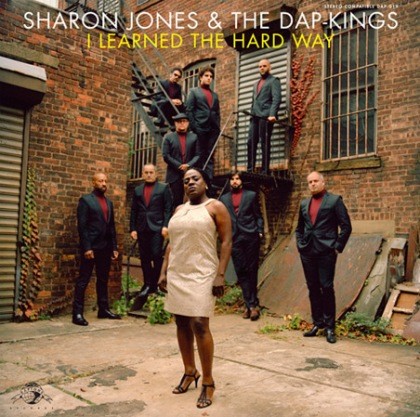 Sharon Jones and The Dap-Kings new album I Learned the Hard Way, out April 6th on Daptone Records, is the latest chapter in the soul saga of Sharon Jones. Less funky, more soulful, this album is slower and deeper. Less of a dance party and more of a soul-session, Sharon Jones and The Dap-Kings have more to say this time around. In the same way 100 Days, 100 Nights, their third album, represent a progression and maturation from their first two releases, I Learned the Hard Way is the next step in their evolution.
The French horns in the opening few bars of the album are a sign of what’s to come: down-tempo, soulful songs that tell a story and convey emotion. Woeful ballads like Window Shopping and The Game Gets Old reflect the mature, well-traveled identity of the band. The intricate horn arrangements on instrumental tracks like The Reason tell a little story all their own.
Better Things, my favorite song on the album, is a more upbeat display of maturity, but it still expresses an urgent dissatisfaction. The band is getting older and has already proved they can play infectiously funky music. Now they’re putting out music that’s honest, music that conveys their weathered emotions.
Mama Don’t Like My Man is a hand-clapping, raw soul song that speaks to the authentic down-home style at the core of who Sharon Jones and The Dap-Kings are. Simply a guitar, bass, some hand-claps, foot-stomps, and harmonized vocals combine to create as true and soulful a song you’re likely to hear.
Honestly, I was a little surprised when I heard this album for the first time. I was expecting some raw funk, authentic dance music. This album isn’t that. It’s more than that. It’s raw, authentic soul music that tells a story. Put on one of their earlier albums if you want to have a dance party.
Thursday, March 18, 2010
Album Review: Rise and Shine-Sierra Leone's Refugee All-Stars

Rise and Shine, the new album from Sierra Leone’s Refugee All-Stars out March 23rd on Cumbancha Records, is a celebration of life, music, and overcoming adversity. Recorded both in Freetown, Sierra Leone and New Orleans, Louisiana, a multitude of styles and sounds are blended in thirteen tracks that tap into a sincere commonality and diversity at the same time.
New Orleans style horns contribute to an already interesting mix of reggae and Sierra Leonie traditional songs. All three styles have common roots, fostering a globalized fusion of sounds that take on the identity of the well-traveled musicians. Serving as the cultural ambassadors of Sierra Leone, The All-Stars have toured the world several times and are about to embark on a US tour in support of their new album.
It’s a perfect match both musically as well as philosophically for The All-Stars to team up with some of New Orleans best horn players. Both groups of musicians have dealt with losing their homes and overcoming incredible adversity. That resiliency is apparent throughout the album. A range of emotions is on display from song to song, in true New Orleans fashion, expressing a melancholy downtrodden vibe on songs like Bend Down the Corner and Dununya but then turning around with upbeat tracks like Tamagbondorsu and Jah Come Down.
Sierra Leone Refugee All-Stars ability to use their harrowing experiences as inspiration for truly beautiful music is a powerful message to the rest of the world. What I love the most about this album is the happy, upbeat mood they convey while still managing to include the other end of the spectrum. The All-Stars Represent how contemporary African musicians are synthesizing different influences, both modern and traditional, to create a new original sound.
As I said before, they’re touring the US to promote their new album. Definitely check them out and see what they’re all about. US Tour Dates:
April 7 Burlington, VT Higher Ground
April 10 Woodstock, VT Woodstock Town Hall Theatre
April 11 Allston, MA Harper’s Ferry
April 12 Philadelphia, PA World Café Live
April 14 New York, NY Highline Ballroom
April 16 Vail, CO Downtown Vail, Outdoor Stage Spring Back to Vail
April 17 Dallas, TX Granada Theater
April 18 Austin, TX Auditorium Shores Austin Reggae Festival
April 20 Austin, TX Flamingo Cantina
April 21 Little Rock, AR Revolution Music Room
April 22 Memphis, TN Hi Tone Cafe
April 23 Nashville, TN Alumni Lawn, Vanderbilt University
April 24 New Orleans, LA House of Blues – The Parish
April 25 Lafayette, LA Jefferson Street Stage Festival International de Louisiane
April 27 Atlanta, GA Smith’s Olde Bar
May 2 New Orleans, LA New Orleans Jazz & Heritage Festival
May 5 Santa Fe, NM Santa Fe Brewing Company
May 6 Flagstaff, AZ The Green Room
May 7 Tucson, AZ Rialto Theater
May 8 Phoenix, AZ Musical Instrument Museum Music Theater
May 9 Phoenix, AZ Musical Instrument Museum Music Theater
May 11 Solana Beach, CA Belly Up
May 12 West Hollywood, CA The Roxy
May 14 Santa Cruz, CA Moe’s Alley
May 15 San Francisco, CA The Independent
May 18 Bend, OR Tower Theater
May 19 Seattle, WA Triple Door
May 20 Portland, OR Berbati’s Pan
May 22 Salt Lake City, UT Washington Square Living Traditions Festival
Tuesday, March 16, 2010
Underground System-Super Hi-Fi @ Public Assembly Tomorrow Night

Two dope new bands on the NY afro-scene are playing tomorrow night at Public Assembly in Williamsburg. Underground System is a new band featuring members of Amayo's Fu Arkist Ra as well as a host of other veterans of the scene. Super Hi-Fi, the new project led by Aphrodesia bassist Ezra Gale, are joining Underground System and DJ Rodan to celebrate St. Paddy's Day with some afro-dub flavor. If you're in BK and interested in celebrating St. Patrick's Day with some afro-grooves, check it out.
Saturday, March 13, 2010
Album Review: Blue Eyed Black Boy-Balkan Beat Box
 Balkan Beat Box is out to prove why they’re one of the most dynamic acts on the planet with their third full-length album Blue Eyed Black Boy set to be released April 2010 on National Geographic Records in the US and Crammed Discs internationally. Infectiously danceable, uniquely innovative, and politically relevant, Blue Eyed Black Boy is BBB’s best album yet, expanding on their tradition of fusing disparate global elements to create a sound all their own.
When I interviewed drummer-producer-band founder Tamir Muskat in April 2009, he described how their upcoming album would be more personal, how they would express themselves politically and emotionally, something “they hadn’t done before.” True to his word, BBB takes an increasingly political stance in Blue Eyed Black Boy. Balkan Beat Box’s mission is to erase borders and build connections with their music, but never before have they made such outwardly political statements on their records. Songs like War Again, Look Them Act, and Why all speak out against war and institutions of power.
Horn player-co-founder Ori Kaplan, also told me about new rhythms and influences they were incorporating inspired by places in Latin America they’ve performed. Tracks like Balcumbia, Dancing With The Moon, and Marcha De La Vida affirm the exploration of Latin American rhythms and sounds to which Kaplan alluded, but Latin America isn’t the only place BBB has toured extensively that made an impression on them. Buhala features Moroccan musician Hassan Ben Jaffar, incorporating a Gnawan element into their already diverse presentation.
Part of the album was recorded in Belgrade, Serbia and features local musicians from renowned Roma orchestras. Tamir Muskat combines the traditional horns, accordion, and vocals with hard-hitting beats and bass lines to elevate the Balkan flavor to a new level, Balkan Beat Box’s signature sound. Tracks like Kabulectro Smartron and Lijepa Mare all feature ferociously intricate horn, accordian and vocal lines that mesh perfectly with Muskat’s punishing drum and bass lines.
Last but not least, several songs have an unmistakably bluesy, American feel. The album’s title track has some heavy blues guitar as well as Dancing With The Moon and My Baby. My favorite track on the album, Look Them Act, has a strong hip-hop vibe as well. It should come as no surprise to anyone familiar with BBB to see American music featured so prominently considering the group came to be in New York City. They’ve often ascribed the multitude of musical influences New York has to offer for the band’s creation and evolution; that evolution is extremely evident on this album.
Balkan Beat Box has already established a noteworthy reputation the world over with their first three albums for creating innovative, original music that combines elements from different parts of the globe. This album builds on that progress, elevating the global music scene to a new level. They are truly unique in their ability to make a powerful statement.
Tuesday, March 9, 2010
Afrofunky this Thursday Night

Afrofunky!, the afrofunkiest monthly dance party in Brooklyn is goin down this Thursday night at Cameo Gallery. Hosts Zongo Junction are being joined by No Small Money Brass Band, Emefe and DJ Stylus. No Small Money Brass Band is a monstrosity of Ghanaian big band flavor that is truly not to be missed. Admission is $5, come to this jam prepared to get funky--afrofunky!
Tuesday, March 2, 2010
Album Review: Ali and Toumani-Ali Farka Touré and Toumani Diabaté
 Ali and Toumani, the new album out February 23rd on Nonesuch Records/World Circuit, is a beautifully enchanting collection of songs that add to the legendary careers of two world-class musicians. After winning a Grammy for In the Heart of the Moon in 2005, Ali Farka Touré partners with Toumani Diabaté and Cachaíto López for the second time. Their chemistry and collective brilliance has produced equally praise-worthy results this time around.
Toumani Diabaté educes a heavenly tone with his flowing kora lines, which twist and wind in and around Ali Farka Touré’s guitar melodies. The two legendarily gifted musicians blend their sounds together seamlessly as if they were born to play together. Their songs are enchanting and deep. They convey a calming meditative energy that almost forces relaxation while listening.
If you’re not familiar with either Ali Farka Touré or Toumani Diabaté, this album is a great introduction to both artists. By working together to converge their two styles they create an original, authentically beautiful sound that is truly unique. Anyone can appreciate beautiful music that is relaxing and peaceful, and that’s Ali and Toumani exemplifies most.
Wednesday, February 24, 2010
Afro Jam in San Fran

For all those interested in getting funky in the bay area tomorrow night, Baba Ken and Afro-Groove Connection will be throwing down at the Elbo Room in San Francisco, CA. The Connection boasts a lineup of several vets of Afrika 70 and Egypt 80 as well as King Sunny Ade's former associates. If you're looking to get funky, check them out.
Monday, February 22, 2010
Jeremiah Lockwood's Travel Account of The Festival Au Desert

The Sway Machinery is playing this Saturday night at Littlefield in Gowanus, Brooklyn to benefit Haiti Earthquake Releief. Frequent readers of my blog have read quite a bit about The Sway Machinery's Pilgrimage to Mali to play in The Festival Au Desert and record an album at Ali Farka Toure's studio. This first-hand account of frontman Jeremiah Lockwood's experience, which originally ran here, will provide some insight into the story until the album and documentary about the trip come out:
Americans grow up hearing “Timbuktu” used to mean the most remote place in the world. Though readily reachable these days, the real city of Timbuktu, Mali, is indeed touched by the color of the exotically magical. The city is made up of red dusty bricks that look as though they might blow away if not for the binding spell of an incantation. But the true magic of this city is in its incomparable cultural riches.
On our first night in Timbuktu, our friend and tour guide, Mahmoud Arawane, had invited the great singer Khaira Arby to meet us on the rooftop of the house where we were staying. Arby came with her whole band, some of the best musicians in the area, and we played an impromptu concert together under the stars for an audience of a few European tourists and a group of young Tuareg men. The unexpected intensity of our reception, and the sheer joy of music-making in this fantastical atmosphere, made this one of the most exhilarating musical moments of my life.
At the Festival au Desert, held just outside Timbuktu this year, we performed for an audience of thousands. As the first performers of Jewish music to be playing at the festival, I was overjoyed by the welcome we received. The crowd, which was predominantly made up of traditionally garbed desert-dwelling Tuareg, seemed to be both intrigued by the unaccustomed American sound of our music and filled with a surprising affinity for what they were hearing. Despite the foreign rhythms and energy, The Sway Machinery’s integration of spiritual music into secular music culture is a very familiar idea to Malians.
The idea of playing with traditions and fusing disparate musical worlds is a staple of Malian music. When I introduced one song in our set as being by my grandfather, Cantor Jacob Konigsberg, many in the audience clapped and cheered. They did not need to have any notion of what a cantor is to feel the value of a young man carrying on family tradition. Seeing turbaned men pumping their fists in the air along with my grandfather’s “Aveinu Malkeinu Z’khor” is certainly one of the most memorable and inspiring images from our journey.
From a Jewish perspective, Mali is perhaps uniquely well situated in the Muslim world to welcome cultural interaction. I came to Mali making my Jewishness very public, and I met nothing but respectful curiosity and friendly interest. Mali has an amazing potential to be a point of positive image-changing in the world of Jewish-Islamic relations. It is an Islamic nation with an incredibly welcoming and warm society that is deeply comfortable with the notion of people belonging to different tribal backgrounds. I would be overjoyed to see more Jews making the trek to Timbuktu, which was once the home of a venerable Jewish community that thrived in the rich culture of this formerly dominant outpost of commerce and learning. The journey is deeply soul expanding.
While at the festival, I made friends with the great Tuareg musician Abdulla Ag Mohamed, percussionist and musical director of the band Tartit. Tuareg men have a charming habit of walking hand in hand together. While we were walking together, Ag Mohamed wanted to hold hands. I manned up and pushed past my cultural discomfort, and we walked together in this way, hand in hand.
Ag Mohamed invited me into a Tuareg tent, where men were singing together in call and response. He nudged me into the circle, and we clapped and sang along. Two little girls were accompanying the group with drums, under the watchful eye of their mother, who was coaching their playing. Everyone was laughing and applauding each other’s creativity with raucous catcalls. In my mind’s eye, I saw the needlepoint on my grandparents’ wall, and I could hear the singing of zemiros, or Jewish hymns, and the sound of nigunim, wordless melodies, with my grandfather and my cousins at my grandfather’s tish. I looked around the faces in the tent and saw the kindness born of mutual respect. And I was grateful because I had been blessed to fulfill a verse of scripture: “Behold how good it is to sit in the unity of brotherhood.”
Friday, February 19, 2010
African Disneyland? A Response to the NY Times

Music Journalist, bassist, band leader, Ezra Gale wrote a thought-provoking essay on FELA! the Bill T. Jones Antibalas broadway production. I'll be on the ones and twos next week at Rose Live Music when Ezra's band Super Hi-Fi will be hitting the stage. This article originally ran on the SLF blog:
This is in response to Charles Isherwood’s article on the Broadway musical “Fela!” in the New York Times on Sunday, January 28, 2010. I took a special interest in his critical take on the show not only because I recently saw the show- which is set at Fela’s Lagos, Nigeria nightclub the Shrine- and not only because I have been a devotee of Fela Kuti’s music and life story for years, but also because in 2006 I had the unforgettable experience of traveling to Lagos, Nigeria with my band, Aphrodesia, where we played at the Shrine with Fela’s son, Femi.
Mr. Isherwood is to be commended for thinking so critically about the musical. Race is, as he notes in his opening paragraph, an incendiary topic, and those of us involved in any debate on it too often devolve into knee-jerk ‘reactionism,’ often fed by notions of political correctness and white guilt. Mr Isherwood’s thoughtful, lengthy critique in a major American newspaper should be taken by fans of afrobeat and of the musical as the highest compliment (he is also right to urge everyone- as I emphatically do as well- to go and see the show for themselves).
That said, Mr. Isherwood is wrong on the major themes of his article.
He’s right that “Fela!” the musical isn’t perfect. The plot is weak, and character development almost nonexistent. The plot could be accurately summarized as “Fela says he’s leaving Nigeria, then he changes his mind.” And although we are witness to the development of Fela’s life through flashbacks, there are no meaningful changes in the portrayals of the major characters through the passage of the show, as is often the case in Broadway productions.
But- and it’s a big but- that’s not the point. “Fela!” is instead a raucous, bombastic, thrilling and at times touching show that transports the audience to a specific time and place- Fela Kuti’s Lagos nightclub, The Shrine, in the late 1970’s. I am no Broadway musical expert, but I believe the show’s positioning of a radical figure like Fela as the hero, its use of Afrobeat, a previously little-known, stubbornly funky and uncompromising music, as the score, and its celebration of strikingly non-Broadway ideas of showmanship, such as African dance and the inclusion of the audience, is groundbreaking for the Great White Way. In essence, “Fela!” brings a new theatrical and musical tradition to Broadway, and Mr. Isherwood mistakenly judges it by his own standard.
One of Mr. Isherwood’s major complaints, for example, is with the look of the show. In crafting a musical that looks (and sounds, thanks to the expert recreation of Fela’s music by a band that includes members of Antibalas) like Fela’s Shrine, the creators of “Fela!” have built a set that Mr Isherwood dismisses as an “African Disneyland.” Yet I found the set design to be one of the most transporting and authentic elements of the show. I should point out that the Shrine I visited and played with Aphrodesia was not the Shrine of the musical- that Shrine was bulldozed by the Nigerian government soon after Fela’s death in 1997. Rather, the Shrine we experienced was Fela’s son Femi’s recreation of his father’s nightclub, in a different neighborhood of Lagos, which he calls “The New Afrika Shrine.” But although the building is different (much bigger, and, we were told by more than one Nigerian, with a much better sound system), by all accounts the vibe and feel of the place is very much the same. And so I can only assume that the set of “Fela!”, looking much like the Shrine I saw, nails the look of the original Shrine. Mr. Isherwood writes that the set is covered in corrugated metal and “African gee-gaws.” Yet I wonder if he is familiar with the clash of cultures that make up the world of Lagos and much of West Africa, where African religious and cultural icons mesh with appropriations of Christian symbols and elements of western culture. Walk down the street in Lagos or Accra and you will find shacks housing businesses with names like “God is Great Beauty Salon” and “He Is Arisen Electrical Shop;” women in traditional cloth dress sell bags of water next to men in business suits talking on their cell phones. It is this world that gave birth to the Shrine, and so while “Fela!”’s set design may have looked contrived to Mr. Isherwood, to me it looked strikingly authentic. At the New Afrika Shrine the slapdash construction of corrugated metal was covered with objects like a giant map of the world with Africa colored in red and a giant slogan that read ‘Movement Against Second Slavery;’ one corner held a religious shrine to Fela. I can only assume the objects that decorated the walls of the original Shrine held a similar significance. An African Disneyland? No, Mr. Isherwood, that musical was named “The Lion King.” This is simply Africa.

Entrance Gate to the Afrika Shrine, Lagos 2006 (Photo by Ezra Gale)
Another of Mr. Isherwood’s complaints is that in walking and dancing among the audience the performers have broken the “Fourth Wall” that normally places performers on stage and audience members in the seats. I’m not enough of an expert on theater to say if this sacred separation of performer and audience is a European construct; I can say though, that the ‘call and response’ format of much West African music- so integral to Fela’s music and deeply influential in much of today’s pop music as well- is rooted in the involvement of everyone present. A singer ‘calls’ a phrase or sentence, the ‘response’ comes from everyone. Music in West Africa often serves a much more universal function than it unfortunately does here in America, where we are bombarded with background music nearly every minute of our day. As I found while I was there, there are songs to telegraph the news from the next village, there are songs for cooking fish without too much salt, and, as Fela proved, there are songs for calling your government a bunch of thieving oligarchs. All of these songs are meant to include the listener in a way that I would guess stands out from Mr. Isherwood’s previous Broadway experience. It is to this tradition that the practice of sending the dancers and performers among the audience, and of asking the audience to sing, and to dance, as “Fela!” does, belongs.
I think Mr. Isherwood’s critique reveals more about himself, and by extension white American attitudes towards race and Africa, than he does about the show. He accuses the show of ‘fetishizing’ the exotic with flashy song and dance, and yet I’d guess there’s nothing exotic about the song and dance in the show to most West Africans, and certainly not to the ones in the mileu portrayed in “Fela!” In tagging the music and dance in the show as belonging to a ‘spectacle of African culture’ that he says tilts too closely towards ‘minstrelsy,’ Mr. Isherwood makes the mistake he accuses the show of making- he assumes that the ‘ecstatic’ music and dance in the show is somehow beneath the dignity of these characters (it reminds me of the argument that music should be taught in schools because it helps kids with math, to which my response has always been, ‘Really? Maybe we should teach math because it helps kids with music’). I think the music and dance in the show is portrayed, accurately, not as light entertainment in service of some higher goal, but as that higher goal itself. And not incidentally, the music and dance (including the beautiful Nigerian women dancing suggestively all night long) portrayed in the show is pretty damn close to the Shrine as I remember it.

Fela!, Eugene O’Neill Theater, New York 2009

Femi Kuti, Afrika Shrine, Lagos 2006 (Photo by Ezra Gale)
Mr. Isherwood seems to believe the emphasis on music and dance is exploitative, but I’d bet Mr. Ishwerwood dinner at Sardi’s that not a single one of the approximately 150 million-plus Nigerians, given the chance to come to Broadway and see the show, would leave the theater feeling exploited. I bet they’d feel proud that this part of their culture and history was being so lovingly crafted and performed in front of such a mainstream American audience every night. I am reminded of my own experience in West Africa. We were a white band, playing African music, in Africa. Before we left we were bombarded with well-meaning concerns from friends about whether the Africans we met would be insulted by what we were doing, whether they would see us as exploiting their culture. But our experience once in Ghana, Togo, Benin and Nigeria was the opposite- people were almost universally thrilled that we were playing their style of music, that we had taken the time to learn it and that we obviously loved it so much we had traveled all the way to Africa to play it and learn more. The questions of authenticity, exploitation and cultural stereotyping and racism that had confronted us faded away as we met Africans who were- rightly- proud that their music and culture was strong enough to make such an impact on people on the other side of the world. We encountered a much more nuanced (and refreshingly blunt) view of race as well- of course, there is black and white, but there are many shades of each. For me, Mr. Isherwood’s critique represents these type of questions- well-meaning, but naïve as to what really constitutes the difference between exploitation and respectful tribute.
Mr. Isherwood says it “seems odd that the only character other than Fela Kuti who has any sustained dialogue is an American.” Actually, it’s not odd: it’s appropriate. Fela’s music was as American as it was African- a synthesis of James Brown funk, American jazz and African Rhythms. And that “brash woman” whom Mr. Isherwood declines to name was Sandra Izadore, who, meeting Fela when he lived in Los Angeles in 1969, introduced him to the politics of the American Black Power movement and the Black Panthers, forever changing his life, music and politics. Far from being the “festive window dressing” Mr. Isherwood accuses the women of Fela of being portrayed as, Ms. Izadore comes across as strong and independent in the musical. Fela is entranced by her, he woos her simplistically, and receives a stack of Black Power literature in return (this portrayal of Ms. Izadore seems correct- I’ve had the priveledge of speaking to her by phone once; she still lives and works in LA, working with community organizations and occaissionally producing afrobeat-themed concerts with local bands like the excellent Afrobeat Down).
I will leave for elsewhere a discussion of Fela’s problematic attitudes towards women (seek out Nkiru Nzegwu’s essay on this in the excellent collection of scholarly articles about Fela, Fela: From West Africa to West Broadway). But the sexuality that Mr. Isherwood seems to find gratuitous and degrading from Fela’s backup dancers and wives in the show (and it was clear to me that they were his wives in the show, perhaps Mr. Isherwood went to the bathroom during the scene when he marries them?) is an accurate portrayal of Fela and his son Femi’s show. The sexuality from the dancers is undeniable; it’s also proud, and I believe here again Mr. Isherwood is imposing his own views and standards uneccesarily.

The “Wives”, Afrika Shrine, Lagos 2006 (photo by Ezra Gale)
Mr. Isherwood discounts the political context given in the show by saying that “you learn more about the sociopolitical situation by reading the newspaper headlines in the video projections on the set.” Actually, Nigerian soldiers’ raid on his compound and the murdering of his mother by them is the main dramatic episode in the show. This event- a reference to the Kalakuta Raid of February 18, 1977- is put in its proper context as a reaction to Fela’s outspoken criticism of the government’s corruption. The episode when Fela was jailed for marijuana possession, but released after several days for lack of evidence (the creative details of which make for one of the more entertaining passages in the show, and which yielded his classic song, “Expensive Shit”), appropriately portrays a government furious at his dissent, yet fearful of confronting his enormous popularity. Yes, there are political elements left out- viewers will have to dig elsewhere to learn about the bloody Biafran War of 1967-70, a civil war estimated to have killed as many as three million people and which shaped the political culture of the Nigeria inhabited by Fela (and perhaps even more importantly, by his politically outspoken mother, too). Absent too is talk to the ethnic tensions within Nigeria between the Igbo and other groups like Fela’s Yoruba, which contributed to that war and were exacerbated by Britain’s colonial administration, itself touched on but not deeply examined in the show.
But a full revealing of these political complexities would turn the show into more of a lecture and less of an entertainment. And that’s what Mr. Isherwood misses in his critique- this is a show, and deservedly so. Fela knew that his politics had to be coupled with his music to gain traction with the population; likewise, the musical “Fela!” would be sorely off-base if it left out the sensual side of its main character.
The show is far from perfect- for that, the plot and narrative would have to match Bill T. Jones’ breathtaking choreography and the irresistible Antibalas-fueled live soundtrack. But what flaws it has do not stem from exploitation or racist assumptions about Africans and African culture.
Monday, February 15, 2010
Sign The Petition to Stop The Death Penalty for Homosexuality in Uganda
 For those unfamiliar with the story, The Ugandan Parliament is considering passing legislation to institute a death penalty for homosexuality. Homosexuality is against the law in Uganda, similar to many countries in East Africa, but the death penalty is new extreme. What's even more sickening is the initiative was proposed and provoked by a right-wing American lobbying organization. It's bad enough that people in The United States are willing to espouse such radically homophobic extremist views, but the idea that these dementedly sadistic people would go to such extremes to see to it that legislation is passed in foreign countries is downright horrifying. Where do people get off pushing their views on foreign cultures and societies? What do they really stand to gain from all of this? When people go to such extremes it makes me embarrassed to be an American.
What can you do to put a stop to this? Unfortunately not that much (don't let me speak for you, if you have the power to make a difference please prove me wrong), but you can SIGN THIS PETITION. At least then you can say you made your opinion known and you spoke out against what's wrong.
Saturday, February 13, 2010
Janka Nabay-Bubu King EP
 Every now and then, something comes along that's totally different. Something that sounds nothing like anything I've heard before. Janka Nabay definitely falls into that category. Janka Nabay is the self-proclaimed father of Bubu music in Sierra Leone. Bubu music has its roots in Timini Muslim feasts that Janka attended as a young boy. He is the first to modernize the music employing electronic keyboards, carburetor pipes and bamboo shoots. He creates an underproduced, almost amateur feeling, trance-like sound that is totally unique. Check him out on Itunes, or order the 12-inch EP from True Panther records.
Subscribe to:
Posts (Atom)


