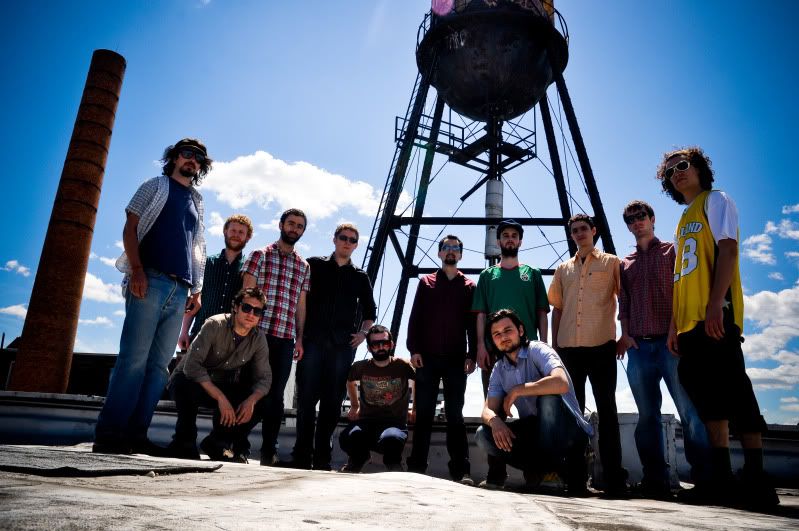
Akoya Afrobeat Ensemble - Wahala by afrobeatblog
Monday, November 29, 2010
Akoya Afrobeat Ensemble at Southpaw Next Friday Night
Akoya Afrobeat Ensemble - Wahala by afrobeatblog
Labels:
afrobeat akoya brooklyn southpaw
Chorizo Chunks 9
Chorizo Chunks 9 - DJ Chorizo Funk Live @ Night Fever V. 7 by chorizofunk
Monday, November 22, 2010
New Sofrito Tropical Discotheque Mixtape
If you've been to one of the legendary Sofrito Tropical Discotheque Parties in either London, Brooklyn, Greece, or wherever else, you don't need me to tell you, they know how to make people dance. If you haven't, check out this track from their new comp due out January 24th of 2011 on Strut Records.Fair Nick Stars - Arrete Mal Parle by afrobeatblog
Tuesday, November 16, 2010
Concert Review: Luisa Maita at Lula Lounge, Toronto-November 12, 2010 (photos courtesy of Dave Burke)
Luisa kicked the night off with an early performance around 8:30. Performing for the first time in Canada, she came across as being truly honored such a large audience was in attendance. Her performance was full of passion, and the crowd responded to her energy enthusiastically.
Next up on the bill was Rode de Samba, a Toronto based Samba ensemble. As their set went on, the audience began to congregate in front of the stage singing along to their songs and dancing. The six-piece ensemble injected a large dose of energy into the night after Luisa Maita's mellow performance that set the tone for the rest of the night.
Baque de Bamba, a maracatu ensemble led by Aline Morales, followed Rode de Samba, and picked up where they left off. The thundering drums of the legion of percussionists filled the room with an incredible energy that unleashed a frenzy on the dancefloor. Morales voice contrasted beautifully with the percussion backdrop as she sang in Portuguese. I was totally blown away by the power and energy of Baque de Bamba, and I definitely hope to see them again sometime soon.Rino finished off the night with a bang. Rino featured guitar, bass, trombone, trap drums, as well as maracatu bass drums creating a loud, intensely unique sound. They combined elements of funk, rock, samba, and something totally new and original. Watching a band cover songs by Jorge Ben with a presentation similar to punk rock was something I've never seen before. Despite a somewhat lengthy gap between their performance and Baque de Bambe while they setup, Rino managed to not lose any of the energy that was building throughout the night.
This Post is Supported by Concert Tickets Toronto 2011
Monday, November 8, 2010
Album Review: Afrocubism
Afrocubism - DJelimady Rumba by afrobeatblog
The album came out November 2, 2010 on World Circuit Records, and has universally lived up to the astronomical expectations which preceded it. It's infinitely interesting to listen to this album and ponder whether the African or Cuban elements are more prominent. It's a nearly impossible task to decipher since Cuban music is deeply influenced by its African roots. In part for that reason, West African music is deeply influenced by Cuban music. Francophone West African post-colonial governments also sent their budding musicians to train in Havana which helped usher in a generation of African musicians who were trained to emulate the Cuban aesthetic. Records and 45s from several Latin-American countries were widely distributed and consumed throughout West Africa beginning around the 1950's. Djelimady Tounkara even honed his guitar skills by accompanying Cuban radio hits.
This album has an entrancing sound that flows from song to song. Djelimady's mesmerizing guitar meshes with the relentlessly propulsive churning bass, gliding over the backdrop of congas, shekere, guiro, tala, and other varied percussion. Ochoa's vocals blend perfectly with the instrumental backdrop. Certain songs feature one instrumentalist more than others, such as Dakan featuring Bassekou Kouyate, Djelimady Rumba featuring Djelimady Tounkara, and Eliades Tumbao 27 featuring Eliades Ochoa. The instrument that provides the most character to the album throughout, in my opinion, is the balafon. It cuts through the already rich texture and adds a concise timbre to the composition.
This album is a testament to the cross-cultural exchange that has occurred for centuries and made its creation possible. Hopefully it will serve as inspiration for future collaborations. The ensemble is performing at Town Hall in midtown Manhattan tomorrow night and then touring Europe. If you are in any way able, I highly recommend seeing this group of musicians live. This collection of music provides a new definition to the term, Afro-Cuban.
Tuesday, November 2, 2010
Luisa Maita - New Remix Album - N. American Tour
Luisa Maita - Lero-Lero (Seiji Remix) by afrobeatblog
If you can make it to one of the cities on Luisa's tour schedule, definitely check out this rising star while you have the chance:
11-03 New York, NY - S.O.B.'s
11-04 Washington D.C. - Bohemian Caverns
11-05 Philadelphia, PA - Kimmel Center
11-06 Montreal, QC - Belle et Bum
11-07 Burlington, VT - Flynn Space
11-09 Portland, ME - One Longfellow Square
11-10 Somerville, MA - Johnny D's
11-11 Montreal, QC - Balattou
11-12 Toronto, ON - Lula Lounge
11-13 Chicago, IL - Logan Square
11-14 Minneapolis, MN - Cedar Cultural Center
11-15 San Francisco, CA - Amoeba Records Instore
11-16 San Francisco, CA - Yoshi's
11-17 Santa Cruz, CA - Kuumbwa Jazz Center
11-18 Los Angeles, CA - KCRW's Morning Becomes Eclectic
11-19 Los Angeles, CA - Conga Room
Monday, November 1, 2010
Album Review: Hard Proof
I've often said, it's much harder to play slow afrobeat well than fast, and this album is a great example of how to execute a dynamic range. Utilizing slow, winding, interlocking guitar grooves, multi-layered percussion, and deep horn arrangements, Hard Proof sets a down-tempo, sinister mood on tracks such as Stolen Goods, Jimma and Mahout. They pick up the tempo on tracks like No Consideration, Buffalo, and Move In, but it's the slower tracks that creep along that truly stick out on this album.
Hard Proof will be celebrating the release of their new album on November 19th at the Ghost Room in Austin. If you're in the Lone Star State and you're hungry for some afro-love, definitely check them out. I haven't seen them live in concert yet, but listening to the album, you can hear their ability to push, build and release the energy of the music from song to song.
Hard Proof - Jimma by afrobeatblog
Bouncing Cats-New Film about Hip-Hop Culture in Uganda
Bouncing Cats is the inspiring story of one man's attempt to create a better life for the children of Uganda using the unlikely tool of hip-hop with a focus on b-boy culture and breakdance. The film features narration by Common and interviews with Will.I.Am, and K'Naan. Stay tuned for screenings in your community. Get tickets for the DC screening here.Bouncing Cats Trailer from Bouncing Cats on Vimeo.
Sunday, October 24, 2010
Society HAE Interview w/ Femi Kuti
Find more videos like this on SOCIETY HAE
Check out this dope interview Ngozi from Society HAE did with Femi Kuti
New Superhuman Happiness Video
GMYL by Superhuman Happiness from Tatiana McCabe on Vimeo.
Don't you love it when one of your favorite bands makes a video for one of their best songs, and the video makes you love the song even more? I do. Check out this new one for Superhuman Happiness' jam GMYL by Tatiana McCabe.Sunday, October 17, 2010
Sapabonde Remix EP
Help Kickstart Zongo Junction's First Album
Ebo Taylor-Love and Death
Friday, October 15, 2010
Fela Day
Tuesday, October 12, 2010
Felabration 2010
It's that time of year again. Olufela Olusegun Oludotun Ransome-Kuti was born in Abeokuta, Nigeria on October 15, 1938. He went on to make an indelible mark on the world, musically and otherwise, under the name Fela Anikulapo Kuti. As his birthday approaches, the world will rightfully celebrate the day he was born. The flyer below shows a list of parties across the United States where Fela's legacy will be alive and well. Come prepared to party like you know you should, "Everybody say yeeeeaaaahhh yeeeaahhh!!!"
Monday, October 11, 2010
Album Review: Afrolution Vol 2-The Original African Hip Hop Collection-Various Artists
Afrolution is a UK-based website, label, and web TV station offering videos, interviews and more, all focused on the ongoing wave of young musical acts emerging from the continent. This is their second African hip-hop compilation. Their first, Yes We Can, featured artists like K'Naan who have left the continent. This album features mostly artists who still reside, representing twelve nations in East, West, and Southern Africa.
My favorite track off the album is Green Card by Wanlov the Kubolor from Ghana. It details a common predicament immigrants face, "Just to get of the slave yard, I must fight to get us a green card." Other tracks that distinguish themselves from the rest are She Smiles Easy by Goreala from Kenya and My People by Negrissim from Cameroon. Some tracks incorporate live instrumentation into their presentation such as Trenton and The Free Radicals and Tumi and The Volume, both from South Africa.
The wide range of nations represented on this album shows how wide ranging the African hip-hop movement is becoming, and outlets like Afrolution are greatly contributing to its proliferation.
Sunday, October 3, 2010
Interview with Martin Perna
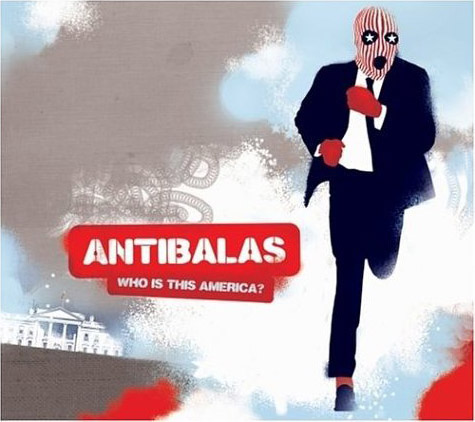
Marc Gabriel Amigone: When I listen to Who Is This America, I feel like I'm listening to a horror movie soundtrack. How does that jive with the mood and attitude you guys were going for when you wrote the album?
Martin Perna: Haha, well, the United States is definitely in the role of the climax of a particular type of horror movie in that time. You know, we didn't really sit down and say let's write a concept album, let's cover these songs. It was what was in everybody's head. And it was in the heads of the specific people who wrote those songs, but because we work as a collective, it was in everybody else's heads too. We were like alright, we see where you're coming from, cool, I didn't write it, but I'm down with it, let's do it, let's record it. And living in New York, the days after September 11th were some of the brightest moments that we had ever experienced living in new york in terms of seeing how kind and how generous and helpful people can be like that tragedy created a sense of community at least for a minute, that has never been created, at least in our lifetimes before or since. That moment was hijacked. For me the tragedy of the planes was a tragedy, but the bigger tragedy was how that moment has hijacked. And how that tragedy became basically a pretext to hijacked democracy, hijacked the world.
Martin Perna: Who Is This America? was before the second Bush Elections. Actually we finished the album in the spring of 04 and we toured all summer. Our second to last date on that tour after being on the road for months was in Portland, Maine the night of the Bush-Kerry election. It was this dark rainy night. It was funny because the tour was pretty good and we were pulling into Maine, and I was like, 'Man it's cool we didn't have to play any sports bars or have any rude awakenings.' And low and behold, when we showed up, the place that our agent had booked us at was this sports bar with all these big televisions. So we were playing and watching the election results come in, and the night just got darker and more and more depressing.
Marc Gabriel Amigone: So it was like a horror movie in a way?
MP: Yea, yea it was like playing the soundtrack to all these horrible things going on. Um, so yea it was definitely distopian and angry, and kind of like why? I don't think we ever felt alone in it, but this still is a culture of like, if you're a patriot you don't, patriotism and descent are like opposite sides of the coin.
MGA: That used to piss me off so much when people would say that shit, it used to drive me crazy when people would try to make that claim.
MP: But as a band none of us really bought that. And that's a cool thing, that there's an understanding and enough support that Stuart Bogie could go and write a song like Indictment, and we're all right there behind him. Or a song like Big Man. And I think a lot of our stuff, just in the vain of afrobeat it's a music that it's time still hasn't really come. More people know about it and are sort of attuned to it, but I still think it's very futuristic music because as the years go on, whether it's Fela's compositions or stuff that we're writing, it just becomes more and more relevant, rather than less relevant. It's a major difference between what some flash in the pan indie rock or some rock band will wear some crazy shit or be part of a look but it's like a fad. And Afrobeat's never been a fad for us. We're evolving but the intention and the feelings behind the songs are something that's momentary, but it's larger and deeper than that.
MGA: Now that the album's being re-released, where in today's political context do you see Who Is This America fitting? Where does it still apply?
MP: I feel like it's part of a lineage of other, I don't know if people consider it a concept album, looking back I don't know if it was a deliberate deliberate concept album because that's just where our heads were at but there are other albums that I like that I still listen to like Eugene McDaniels' Headless Horsemen of the Apocalypse. I don't know if you know the album but if you listen to it, you'll hear like thirty classic hip-hop samples in it. And he was writing that during Nixon's era in the 1970's, and it's a statement of the times that was never really necessarily meant to be like, he didn't put it out saying this is a statement of our times.
MGA: Right he was just reacting.
MP: He was calling it as he sees it, but you realize that compared to a lot of other albums, people really don't call it as they see it. Either they're trying to be fashionable or caught up on their own personal bullshit and they're working that out on the album or something. It's something that we're proud of that we're happy we were able to create and I don't know if it's changed or anything. You know we have a different president but the conditions are pretty much the same as they were when we wrote it, you know there's all this political double speak and the wealth in the United States, just looking at a song like Big Man, you know, the whole financial crisis, it's just a a continuation of the reshuffling of wealth from the poor to the rich, it was one of the largest losses of wealth by the black and latino communities in the history of the country. Stuff has gotten a lot worse since then. We all hoped that stuff would get better, and it wasn't like we're making this album and we had any illusions that, we're going to make this album and America's going to get better, but it's not our job to fix all these problems. What is our job as musicians is to be present and bare witness to these things and name them and try to express them in ways that other people can connect to.
MGA: Right, to speak out. Similar to other artists, particularly Fela how he was able to frame the argument and be the commentator. Draw attention to certain things that other people were afraid to say. I feel like your guys' album and the statement that it made was just like coming out and saying it. And, like you said, not everybody was willing to do that for whatever reason. And there's not a lot of people who would of made that statement at that time. Just when you play the song, Who Is This America?, when the horns come in on that song, it just kind of like, boom, it just hits you. It wakes you up, and calls you to attention, you know? And I think that's the function that the music really plays, trying to wake people up and ask the pertinent questions.
MP: Well, I mean that's the idea. Because the songs are so long, you can really flesh out certain ideas, and you can have 7, 9, 12, 19 minutes to flesh out an idea, you can basically do this subconscious mental climbing of the mind, where you can cognitively get people in a better place to receive those messages than if you try and cram everything into a three minute pop song.
MGA: Yea, totally. What was the reaction like when you guys toured, you mentioned you finished the tour in Maine on election night, what was the reaction like as you toured around the country?
MP: Well, I mean we were basically 3 and half years through the first Bush term and I think the tour in a lot of ways brought a lot people together who were furious and were horrified that this was happneing and we don't want this to happen anymore and this has got to stop. We don't know how but coming to a place where people are thinking the same way makes us feel good and hearing a band that's up on stage that isn't afraid, that's foolish enough, or unafraid enough or both to make songs about the same things we're talking about at work or around the kitchen table. It definitely created a sense of community. You know again, America in so many ways has been one disappointment after another, one false hope after another. I'm optimistic, but really, I volunteered and campaigned for Obama, I don't even want to go into it. I"m not really quite sure what it's going to take to see America become what it is capable of becoming because there are too many powerful people here who are too comfortable with the power that they have and really not try to extend that to anyone else.
MGA: Did you guys tour abroad after it came out?
MP: Yea in 04 we had been in France for something like 6 weeks. In 2004-2005 we were there quite a bit. We did a total of like 3 and a half months over those two years.
MGA: And did you guys play Womex around then?
MP: Yea we did Womex before the album came out in 03 in Seville.
MGA: Yea because someone told me they saw you guys there and the reception was really great, like you guys really brought it and people were really charged about what you guys were putting out.
MP: Yea it was a really good reception. We were the only band from North America that was invited to play, so that was really quite an honor because there's some really fantastic bands in North America, but the world music community in certain ways feels that America doesn't need any help promoting American music.
MGA: Yea, because we have the mainstream music culture.
MP: Right. So that those critical audiences and curators found value in our music and thought it was relevant. And didn't choose all of these other fantastic artists that could have been there and were playing whether it was Puerto Rican music or Tejano music, or country, or bluegrass or anything like that, but I feel a lot of that had to with the fact that we were from here but speaking to these ideas that generally, it wasn't just a national disappointment what was going on in the United States but a global disappointment. I think Bush being elected and the way that the response to September 11th was like, if anyone had it in their mind that the United States was still a friendly global superpower, all of that shit was washed away. Just in the way all of that was handled and just overnight, um, Muslims, particularly of Middle-Eastern descent were criminalized.
MGA: Right, and people just rounded up and locked up illegally and stuff.
MP: Yea, it's horrible, and it's still happening. It's still horrible.
MGA: Yea it just goes back to the way you described it as a hijacking. The international community was so behind the United States and was so willing to work with us. Even the people who came out to criticize us, the French government or the German government, when 911 happened everyone stood with us, and then we just flushed that all down the toilet. It all just went away the way that the government handled it. It's a really sad story in American history for sure.
MP: Yea
MGA: The first time I met you, when I interviewed you in 2007 at Governor's Island, I asked you if you feel like Antibalas carries the torch for Fela's legacy. Your answer was that's something people gave you but not necessarily something you wanted. You used the metaphor of a fruitcake, nobody really wants it, but it's been given to you so you're stuck with it.
MP: Hahaha, that's funny, yea I remember that. I still feel like it's like that. If you're a serious musician in any genre of music, inevitably you're going to try to honor the people that came before you. That created or contributed to that history and that lineage and that architecture.
MGA: But you want to be your own artist.
MP: But even more than what we want, we're from New York, we're a multi-cultural group, we're in the digital era. His torch, I don't know if anybody can carry his torch. You know even his sons who are in so many ways so much closer to his legacy, I don't think they're carrying it, Fela was a force of nature.
MGA: Well the reason why I asked is, now that the band is associated with the FELA! Broadway production which is introducing so many people to who Fela was and what his music was all about, it's kind of been re-dubbed upon the band. People considered Antibalas to be a torch-bearer before the play started its run, but now its on another level. That's why I asked the question.
MP: It's definitely not bad that we're associated with Fela, I don't think we'll ever disassociate. It's a real strange position to find yourself in because people inevitably place expectations on you, that you sound too much like him or not enough like him. Or people will listen to an album and say, it sounds just like Fela, and there are only two or three songs that really fit into the classical afrobeat mold, and there's all this crazy other shit on the album too. I think those pronouncements have a lot more to do with people, and music journalists', and the public's lack of literacy in music than actually what we're trying to do or what our musical goals are.
MGA: Yea it's more the reception than what you guys are putting out.
MP: It's like if you really really know music, you can listen to us and hear so many other things besides Fela that are so much stronger and more pronounced than Fela, but because they're so much more underground, Fela is the most recognizable thing. Like I remember the first 45 we put out in 98 or 99 and someone was talking about it in this column in Vibe Magazine, and he was like 'Wow that sounds like Santana.' Santana was his only frame of reference for a big-ass band that has horns and drums and isn't rock. An old Santana is awesome, I love it. I wasn't insulted by it, but I was just like, 'Ok this is where this guy is.' So I'm happy that people are becoming more musically literate than when we started the group in 98 until now.
MP: The internet barely had anything to do with music when I started the band in 98. If I wanted to burn a CD it took me like an hour and a half to burn a blank CD of some demo. And now, if I google us, I can find places to illegally download our music on like 90 blogs or 130 blogs across the world, but I think the upside of that is that people at least have the opportunity to be more musically literate. Whether they are or how they listen to music, or if they have ADD or if they're paying attention or not, I don't know. Some bands are real good at having real close connections to their fans and I feel like our fans are so broad and diverse that it's not like, some bands are playing to people who are basically exactly like them. You know, they're the same age, the same ethnicity, the same geographic area, the same aesthetic. And when we play it's not like there's a typical Antibalas fan. When you show up you could just as easily be a 65-year old black American who went to Nigeria in the 70's as you could be a 20-something white fresh faced college student whose friend ripped them a cd or put some stuff on their ipod. So that's been difficult because there's not some go to place where we can automatically, all of our fans gravitate to. But when we go out on tour we went to the west coast, this summer we did San Diego to Seattle, we don't have a new record out or anything, and they places were packed, a bunch of the people were sold out so people are still interested in us, and the audiences are as diverse as always. Although a note on the audiences, it depends on where we're booked sometimes we go to a city and sell tickets in a rock club or a world music club, or a festival so the venues which are generally beyond our control will shape the arc of who comes out. As well as the time, the time of the show, the night of the week.
MGA: How would you describe the ebb and flow of Antibalas' playing out as a group these days? With a band that big and the amount of work you guys do as musicians, I'd imagine it's gotta be tough to keep everybody together for long periods of time. What do you see yourself doing over the next couple years? Do you see yourself recording a new album anytime soon?
MP: Yea we have a bunch of stuff in the works. One of the things that we're working on right now is we're recording a bunch of cover tunes, basically recording other people's songs that we like that are really relevant to now. We've had a sort of double or triple curse in terms of breaking out with Antibalas. For starters we're playing this music that's a genre that's completely anathema to American pop music, second, a lot of this music isn't in standard English for people to listen to and get. Then on top of that, our average song is the length of three to four average pop tunes strung together, and all the music we've recorded has been original music. So there's nothing familiar about what we're doing at all.
MP: On a couple occasions, like a couple years ago the folks who are in charge of Bob Marley's catalog asked us to come into the studio, Island Records, asked us to come into the studio to record a couple Bob Marley songs, but not make them sound anything like the original. Totally twisted them, stretch them out, change the tonalities all these different things, recorded them, but that project never came out. One of the songs we recorded, Rat Race, we'd been playing out live, and people loved it, like crazy. People were saying, 'You've gotta record it,' We've discovered this other thing about ourselves that we have this odd particular talent for putting our own stamp on other songs. It sorta seems weird, we don't want to be known as a cover band, but all of our musical heroes from John Coltrane, Mongo Santa Maria, to Miles Davis to, um, whoever, they wrote their own stuff and they put their own voice into compositions written by someone else.
MGA: Right, in the Jazz tradition.
MP: Right, if you take Coltrane for instance, he took some cheesy ass showtune My Favorite Things from the Sound of Music, and made it this whole epic song that's nothing but Coltrane. So we're writing original stuff, but we're doing a whole bunch of different arrangements. Rat Race will be the first thing to come out on vinyl probably in the next month or two. We've had a lot of problems with getting a sold press of it, like actually a physical pressing of it that doesn't sound strong, but that's done along with a new original coming out.
MGA: That's dope.
MP: Yea so the next thing we're sinking our teeth into in terms of recording is covers, which is not something we intended to do but we discovered we have a knack for it, so I think it will be a real interesting thing to put out and record five or six songs that are familiar to people but will be listening to them in a totally unfamiliar way. Just to see what that does to people, you know, are you familiar with the producer Mark Ronson?
MGA: Yea.
MP: Yea he did Amy Winehouse and a bunch of other stuff. He called us the best cover band in the world.
MGA: Wow.
MP: It's kind of a weird compliment. It's sort of backhanded but sort of like well shit there's something to this.
MGA: Coming from Mark Ronson I'd say that's a compliment.
MP: Yea, so he's acknowledging this about us, what can we do with this? How can we actually take that and make something out of it that's interesting and maybe make a record that other people will be motivated to check out maybe our other original stuff or our side projects or something like that.
MGA: That's really cool. I definitely think it's in your best interest to release something now riding the wave of the FELA! production since it's introduced so many people to who you are. Also I guarantee you that almost every Antibalas fan out there is a Bob Marley fan and will love your guys interpretation of it.
MGA: You're living in Texas these days?
MP: Yea I moved down here a couple years ago, and I'm in grad school and married and am making a ton of music and working on some non-for-profit stuff.
MGA: Word, you're studying at UT?
MP: Yea at University of Texas.
MGA: What are you working on?
MP: A Masters in Education Technology.
MGA: That's cool.
MP: Yea, Austin is a good place to be a grad student.
Wednesday, September 29, 2010
AFℝICA ☗FRICA இFRICA 3 Mix Tape
The Lunchbox Theory and DJ Underdog have released the third installment of their afro-inspired mixtape, Africa Africa Africa. If you've heard the first two editions, you'll know what's good for you and download this nugget of afro flavor asap. Get all three installments here.Mos Dub
If you have yet to hear this mixtape, stop what you're doing and check it out.Thursday, September 23, 2010
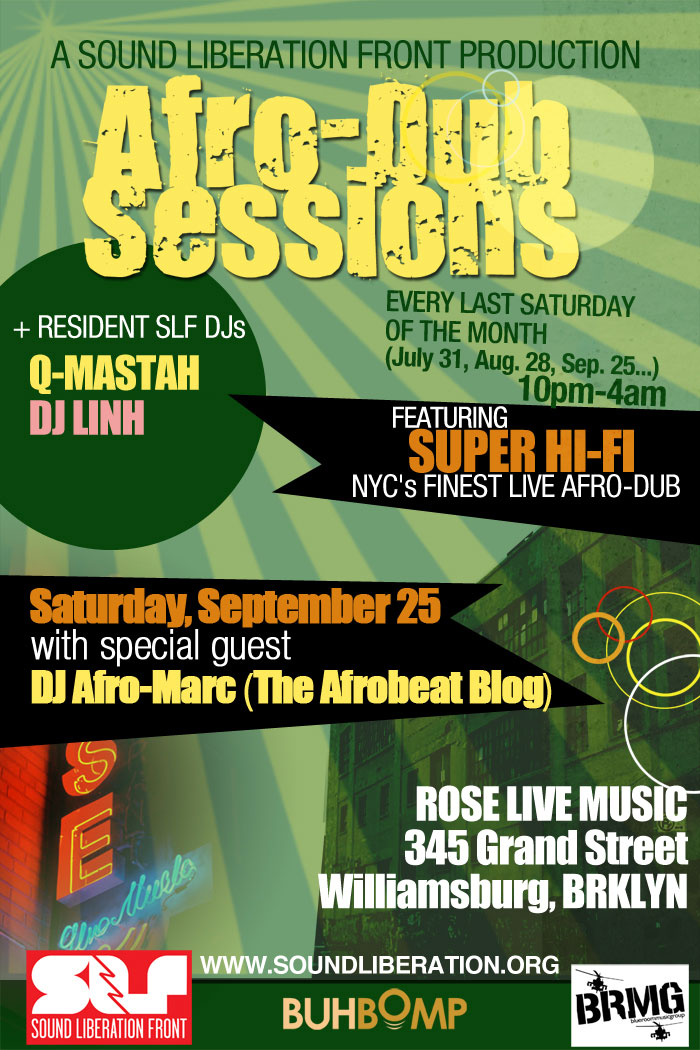
The Afro-Dub Session feat. DJ Afro-Marc @ Rose Live Music Saturday Night
Subscribe to:
Posts (Atom)